Two loans built from the same equity
Both products borrow against the same collateral — the slice of your home you actually own — but they behave nothing alike once the money moves. A home equity loan is a plain installment loan: you receive the full amount at closing, the rate is fixed, and you make the same principal-and-interest payment every month until a known payoff date. It is, in effect, a second mortgage, and it is exactly as predictable as your first one. Our home equity loan calculator breaks that product down on its own, including how much lenders will let you borrow.
A HELOC — home equity line of credit — is revolving credit, closer to a credit card secured by your house. It lives in two phases. During the draw period (usually 10 years), you can borrow, repay, and re-borrow up to your limit, and the minimum payment is typically interest-only on whatever you have drawn. When the draw period ends, the line freezes and the repayment period begins: the outstanding balance amortizes over the remaining term, and the payment jumps — often sharply — because you are suddenly paying principal too. Our HELOC payment calculator covers that product in depth, phase by phase.
The calculator above runs both side by side on the same borrowed amount: the fixed loan amortized straight through, and the HELOC through its full two-phase life, including a stress test for the one variable the HELOC cannot promise you — its rate.
Is a HELOC cheaper than a home equity loan?
On a lump-sum borrowing, usually not — and the reason has almost nothing to do with the headline rates. A HELOC's total interest is the sum of two very different phases:
HELOC total interest = draw-period interest + repayment-period interest
During the draw period the HELOC charges interest-only, so the balance never falls — you pay ten years of interest on the full $50,000 and still owe every dollar of it when the repayment period begins. The fixed loan spends those same ten years retiring principal. Here are the calculator's defaults in full: $50,000, a home equity loan at 8.5% over 15 years, against a HELOC at 9% with a 10-year draw, a 20-year repayment period, and the rate rising 2 points after year 2.
| Home equity loan | HELOC | |
|---|---|---|
| Payment during the first 10 years | $492.37/mo from day one | $375.00/mo interest-only, rising to $458.33/mo after year 2 |
| Payment after the draw period ends | $492.37/mo — unchanged | $516.09/mo for 20 years |
| Debt-free after | 15 years | 30 years |
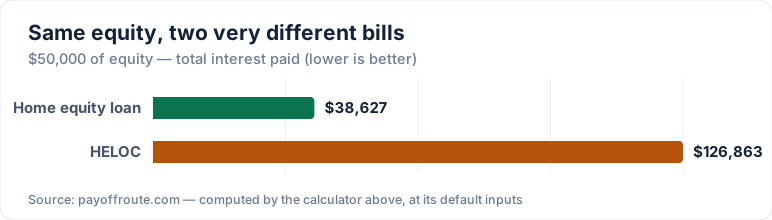
| Total interest | $38,627 | $126,863 |
| Total repaid | $88,627 | $176,863 |
The HELOC's lower monthly payment buys you a loan that lasts twice as long and costs $88,236 more in interest. Even with the rate held flat at 9% — no stress test at all — the HELOC's total interest is $102,967, still far above the fixed loan's $38,627. The gap between $102,967 and $126,863 is the price of rate risk; the gap between $38,627 and $102,967 is the price of ten years of interest-only payments. The second gap is the bigger one, and it is the one borrowers overlook.
That is the case for a lump sum you draw on day one. The HELOC's real advantage doesn't show up in this table at all: if you would draw the money gradually, you pay interest only on what you have actually taken, and the comparison narrows sharply. See “When the HELOC wins” below.
Strip away the mechanics and the rest of the choice comes down to a single question: who absorbs the risk that interest rates rise — you or the lender?
With a home equity loan, the lender carries it. If rates climb three points next year, your payment does not move, and the lender eats the difference between what you pay and what money now costs. You pay for that insurance up front: fixed home equity loan rates typically run a bit above HELOC introductory rates, precisely because certainty is worth something. With a HELOC, the roles reverse. The rate floats with the prime rate, which moves with the Federal Reserve, and every rate hike lands directly on your monthly bill. The lender charges a lower starting rate because it never bears the risk of being locked in below market.
That is why this tool includes a stress test rather than just comparing the two rate sheets. A HELOC that looks half a point cheaper today can end up thousands of dollars more expensive if rates rise mid-loan — and a HELOC's life is long, often 25 or 30 years across both phases, which is plenty of time for several rate cycles. We default the stress test to +2% after year 2 because moves of that size within two years are not extreme scenarios; the prime rate rose more than four points between early 2022 and mid-2023 alone. Run it at "stays flat" and at +3% too, and look at the spread between the answers. That spread is the real price of the HELOC's flexibility.
When the HELOC wins
- Gradual or uncertain spending. A staged renovation, a multi-year tuition plan, an emergency fund of last resort — anywhere you do not need all the money on day one, the HELOC has a structural advantage: you pay interest only on what you have actually drawn. Note that this calculator conservatively assumes you draw the full amount at closing, because that is the only fair head-to-head against a lump-sum loan; if you would realistically draw the funds over two or three years, the HELOC's true cost is lower than shown here.
- You plan to repay fast. Rate risk needs time to hurt you. If the money will be borrowed for two or three years and repaid, the HELOC's lower intro rate and low (often waived) closing costs usually win, and the stress test barely has time to bite. Most HELOCs let you pay principal freely during the draw period.
- Rates are falling. A variable rate cuts both ways. If you believe rates are headed down — or the Fed is visibly in a cutting cycle — the HELOC lets you ride the rate down while home equity loan borrowers stay locked at the old level.
- You want a fixed-rate escape hatch. Many HELOCs now offer fixed-rate lock options that convert part of your drawn balance into a fixed sub-loan. That hybrid lets you start flexible and lock in later if rates start moving against you — ask any lender you are comparing whether they offer it and what it costs.
When the home equity loan wins
- One-shot, known expense. A roof, a debt consolidation, a fixed-bid remodel: if you know the number and need it all at once, the HELOC's draw flexibility is worth nothing to you — you would draw it all on day one anyway, which is exactly the scenario this calculator models.
- Budget certainty matters. One payment, fixed forever, with a payoff date on the calendar. If a payment jump would strain your budget, remember the HELOC has two built-in jumps: rate rises during the whole life of the line, plus the structural jump when interest-only draw payments become full amortizing payments.
- Long borrowing horizons. The longer the money is outstanding, the more chances rates have to rise, and the more the fixed loan's insurance is worth. Over 15 or 20 years, even a modest rate drift can flip the comparison decisively.
- Rising or unpredictable rates. If the stress-test line above makes you uncomfortable, that discomfort is information. The fixed loan converts an open-ended risk into a known price.
- Discipline. A line you can re-draw is a temptation. Plenty of borrowers pay a HELOC down, re-borrow for something less essential, and find the balance still there when the repayment period arrives. An installment loan only goes one direction: down.
Fees and fine print to compare
The rate is the headline, but the fine print can shift the answer — especially on smaller amounts where fees are a bigger share of the total.
Closing costs. Home equity loans typically charge 2–5% of the loan amount at closing — appraisal, title work, origination. HELOCs are often cheaper to open, and many lenders waive closing costs entirely as a promotion. But read the trade-offs: HELOCs frequently carry annual fees ($50–100 is common), sometimes inactivity fees, and often an early-closure fee that claws back the "waived" closing costs if you close the line within the first two or three years.
Draw requirements. Some HELOCs require a minimum initial draw, or minimum amounts per draw, which erodes the pay-only-for-what-you-use advantage. If a lender requires you to draw $25,000 at closing to get the advertised rate, price the product as if that money is borrowed from day one — because it is.
Rate floors and caps. Variable-rate HELOCs come with a lifetime rate cap (federal rules require one) and usually a floor below which the rate will not fall. Ask for the cap number specifically — it bounds your worst case, and two otherwise identical offers can have very different caps. A HELOC at 9% with a 15% cap is a materially different product from one with an 18% cap. The floor matters in the other direction: it limits how much of a falling-rate environment you actually get to enjoy. Get both numbers in writing, then rerun the stress test above with the cap as your worst case.
Frequently Asked Questions
Can I convert a HELOC to a fixed rate later?
Often, yes. Many lenders now offer a fixed-rate lock option that lets you convert some or all of your drawn balance into a fixed-rate, fixed-payment sub-loan — usually for a small fee or a slightly higher rate, and sometimes with limits on how many locks you can hold at once. If rate risk is your main hesitation about a HELOC, ask whether the lender offers this feature and what it costs before you compare products.
Which is easier to qualify for — a HELOC or a home equity loan?
The requirements are broadly similar: both look at your combined loan-to-value ratio (usually capped around 80–85%), credit score, income, and debt-to-income ratio. Some lenders apply slightly stricter credit standards to HELOCs because the variable rate makes future payments less predictable, and they may qualify you at a stressed rate rather than the intro rate. In practice, if you qualify for one you will usually qualify for the other.
Which one affects my credit score more?
Both trigger a hard inquiry and add a new account, so the initial effect is similar and modest. A home equity loan reports as an installment loan, while a HELOC is revolving credit — though most scoring models exclude large home-secured lines from the credit utilization math that applies to credit cards. Over time, on-time payments on either product matter far more than the account type.
Do both options put my home at risk?
Yes. Both a HELOC and a home equity loan are secured by your house, which is exactly why their rates are far below credit cards and personal loans. If you default on either one, the lender can foreclose — even if your first mortgage is current. Never borrow against your home for spending you could not otherwise justify.
Can I have a HELOC and a home equity loan at the same time?
Yes, as long as your total borrowing stays within the lender’s combined loan-to-value limit — typically around 80–85% of your home’s value across the first mortgage and all second liens. Some homeowners pair a fixed home equity loan for a known expense with a small HELOC as a standby emergency line. Each loan is a separate application, closing, and payment.
Why does this tool assume you draw the full HELOC amount on day one?
To keep the comparison apples-to-apples. A home equity loan hands you the full amount at closing, so the HELOC is modeled the same way — full draw from month one. In real life you might draw a HELOC gradually and pay interest only on what you have actually taken, which makes the HELOC cheaper than shown here. Treat the HELOC figures as its worst-case cost for this amount, not its only possible cost.
Does this calculator store my information?
No. All calculations run entirely in your browser. Nothing you type is saved, stored, or sent to any server.
Read more on this
Related calculators
Home Equity Loan
See how much you can borrow against your home and what the monthly payment would be, with a full amortization schedule.
Open calculator →HELOC Payment
Estimate your HELOC payments during the interest-only draw period and the repayment period that follows.
Open calculator →Cash-Out Refi vs HEL
Need cash from your home? Compare replacing your whole mortgage against adding a home equity loan — total interest for each path.
Open calculator →Disclaimer: This calculator is for educational purposes only and provides estimates based on the numbers you enter. It is not financial, legal, or tax advice. Actual loan terms, rates, and payments depend on your lender and personal circumstances. All calculations run in your browser — nothing you enter is stored or sent anywhere.