How 0% balance transfers actually work
A balance transfer moves debt from one credit card to another — usually from a card charging 20–30% APR to a new card offering a 0% introductory rate for a fixed window, commonly 12 to 21 months. During that window, every dollar you pay goes straight to principal instead of being split between principal and interest. That’s the entire appeal, and on a multi-thousand-dollar balance it can be worth hundreds or even thousands of dollars.
But the offer isn’t free. Nearly every transfer card charges a transfer fee of 3–5% of the amount moved, and the fee is added to your new balance upfront. Transfer $6,000 at a 3% fee and you start the promo owing $6,180. The fee is the price of admission, and whether the deal wins depends on whether the interest you avoid exceeds it.
The second thing to understand is the promo clock. The intro rate has a hard expiration date, and it usually starts ticking from account opening — not from when the transfer posts. Whatever balance survives past that date starts accruing interest at the card’s regular APR, which is often higher than the rate on the card you left.
One critical distinction: deferred interest vs. a true 0% rate. Bank-issued balance transfer cards typically offer a genuine 0% period — if a balance remains when the promo ends, interest starts accruing on that remainder from that point forward. Store cards and “special financing” offers, by contrast, often use deferred interest: if even $1 remains at the deadline, they charge you interest retroactively on the entire original amount, as if the promo never existed. Always read the terms and know which kind of offer you’re holding — the difference can be brutal.
Is a balance transfer worth the fee?
It is worth it whenever the interest you avoid is bigger than the fee you pay. Think of the fee as a guaranteed one-time cost and your current card’s interest as an ongoing monthly cost. The transfer wins when the ongoing cost you eliminate exceeds the one-time cost you accept. The fee itself is simple arithmetic:
Transfer fee = balance × fee %
So $6,000 at a 3% fee is $180, added to your balance on day one. Here is how that plays out across common balances — all at a 24.99% APR, paying $250 a month, transferring to a 0% card for 15 months with a 3% fee (27.99% APR afterwards). These are the same figures the calculator above produces:
| Balance | Keep the card | Transfer (fee included) | You save |
|---|---|---|---|
| $3,000 | $488 interest · 1 yr 2 mo | $90 total · 1 yr 1 mo | $398 |
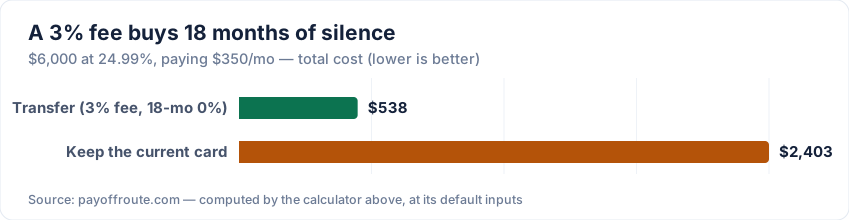
| $6,000 | $2,403 interest · 2 yr 10 mo | $538 total · 2 yr 3 mo | $1,865 |
| $9,000 | $7,801 interest · 5 yr 8 mo | $2,597 total · 3 yr 11 mo | $5,204 |
Notice the $3,000 row: the balance clears inside the 0% window, so the only cost is the $90 fee. The bigger the balance relative to your payment, the more interest the transfer wipes out — and the more the fee is worth paying.
Here’s a worked example. Say you owe $6,000 at 24.99% APR and can pay $250 a month. Your first month’s interest alone is roughly $6,000 × (24.99% ÷ 12) ≈ $125 — half your payment is going to the bank before you touch principal. Riding that card to zero takes about 34 months and costs around $2,400 in interest.
Now transfer to a 0% card for 15 months with a 3% fee. You start at $6,180 (the $180 fee is baked in), but every $250 payment now reduces principal in full. After 15 months you’ve paid off $3,750 and owe about $2,430 when the regular APR kicks in — the remainder takes 12 more months and $358 of interest. Total cost: the $180 fee plus that post-promo interest, still far below the $2,400 you’d have paid by staying put, and you’re debt-free months sooner.
A useful rule of thumb: the transfer tends to win whenever your months-to-payoff × your monthly interest rate comfortably exceeds the fee percentage. At 24.99% APR your monthly rate is about 2.08%, so even two months of avoided interest roughly covers a 3% fee — which is why transfers usually make sense for balances that will take more than a few months to clear. The calculator above skips the approximation and simulates both paths exactly, month by month, with the fee included.
When the transfer doesn’t win: small balances you’ll clear in a month or two (the fee outweighs the interest saved), current cards with unusually low rates, or offers with a short intro window paired with a very high post-promo APR when you know you’ll carry a balance past the deadline.
The promo-expiry trap
Card issuers aren’t running 0% offers as charity. The business model is simple: a meaningful share of customers don’t finish paying during the promo, and the balance that survives starts accruing interest at a regular APR that’s often north of 27%. Add the transfer fee collected upfront, and the issuer profits even from customers who were “saving money.”
The defense is one simple number: the payment that actually finishes the job inside the window.
Required payment = (balance × (1 + fee%)) ÷ intro months
For a $6,000 transfer at a 3% fee with a 15-month promo, that’s $6,180 ÷ 15 ≈ $412 per month. If you can afford that, set up autopay at exactly that amount the day the account opens, and the trap can’t catch you. If you can’t, that’s not necessarily a dealbreaker — the calculator shows you exactly how much will remain at expiry and what it will cost — but go in with your eyes open rather than discovering the leftover balance when the first interest charge posts.
This page answers “is the transfer worth the fee?” — you supply the payment, it returns the savings. If you’ve already decided to transfer and want the opposite answer — “what payment finishes it before the promo dies?” — the balance transfer payoff calculator solves for that payment directly, models deferred-interest offers, and shows what the 1% minimum leaves stranded on the deadline.
Rules that can bite
- New purchases are a different animal. On many transfer cards, purchases don’t get the 0% rate — they accrue interest at the regular APR immediately, and because payments above the minimum are applied to the highest-rate balance first, the accounting gets messy fast. Simplest fix: don’t spend on the transfer card at all. It’s a payoff vehicle, not a wallet card.
- A late payment can void the promo. Most agreements let the issuer cancel the intro rate after a missed due date, repricing your whole balance to the standard or penalty APR. Autopay at least the minimum from day one.
- You usually can’t transfer within the same bank. Chase won’t let you move a Chase balance to another Chase card, and the same goes for most issuers. If your debt is with one bank, look at that bank’s competitors.
- Transfer limits are often below your credit limit. You may be approved for a $10,000 line but capped at transferring $7,500, or a percentage of the limit. You won’t know the exact number until approval, so have a plan for a partial transfer.
- The transfer takes time to post — often one to three weeks. Keep making payments on the old card until you see a $0 balance there, or you risk a late fee on debt you thought you’d already moved.
Alternatives if you don’t qualify
Balance transfer cards with long 0% windows generally require good-to-excellent credit (roughly 670+, with the best offers going to 700+). If that’s not you right now, or the approved transfer limit is too small, you still have solid options:
- Personal loan consolidation. A fixed-rate personal loan often prices well below credit card APRs even for fair credit, and it converts revolving debt into a fixed payment with a guaranteed end date. Run the numbers with our debt consolidation calculator to compare against your current cards, and use the personal loan calculator to see the payment for any rate and term you’re quoted.
- A focused payoff plan on your current cards. No new credit needed — just a strategy. Paying a fixed amount (rather than the shrinking minimum) and directing every extra dollar at your highest-APR card cuts years off the payoff. Our credit card payoff calculator shows how much any given monthly payment shortens the timeline.
- Ask your current issuer for a lower rate. A five-minute phone call mentioning competing offers works more often than people expect, especially with a good payment history. Even a few points off your APR compounds meaningfully over a multi-year payoff.
Whichever route you take, the principle behind this calculator holds: compare total cost to debt-free — every fee and every month of interest included — not the headline rate. That’s the number that actually leaves your pocket.
Frequently Asked Questions
Does a balance transfer hurt my credit score?
Slightly, and briefly. Applying triggers a hard inquiry (a few points, fades within a year) and a new account lowers your average account age. But the new card also adds available credit, which lowers your overall utilization ratio — and utilization is a much bigger scoring factor. If you pay the balance down during the promo, most people end up with a better score than they started with.
Can I transfer balances from more than one card?
Yes. Most issuers let you list several source cards on one application, as long as the combined amount stays under your transfer limit. Each transfer usually incurs its own fee at the same percentage, so the math is the same as transferring one larger balance.
What happens if I miss a payment during the intro period?
Read your card agreement carefully: many issuers reserve the right to end the promotional rate after a late payment, moving your entire remaining balance to the standard purchase APR or a penalty APR immediately. Even one missed due date can erase the entire benefit of the transfer. Set up autopay for at least the minimum on day one.
Can I do multiple balance transfers back-to-back?
It is possible — some people move a remaining balance to a second 0% card when the first promo ends. But each new card means another hard inquiry, another fee, and no guarantee of approval or a large enough limit. Issuers also watch for this pattern. Treat a second transfer as a backup plan, not the strategy; the goal is to finish inside the first window.
What is a typical balance transfer fee?
Most US cards charge 3% to 5% of the amount transferred, with a minimum of $5 to $10. The fee is added to your new balance, so transferring $6,000 at 3% means you start owing $6,180. No-fee transfer offers exist but are uncommon and usually come with shorter intro periods.
Why do I still owe interest even during the 0% period?
Two common reasons: new purchases on the transfer card often accrue interest at the regular rate from day one (the 0% may apply only to the transferred balance), and store-card "special financing" offers frequently use deferred interest — if any balance remains at the end, interest is charged retroactively on the whole original amount. Bank balance-transfer cards typically do not defer, but always check the terms.
Is my information stored?
No. All calculations happen in your browser. Nothing you enter is saved or transmitted anywhere.
Read more on this
Minimum Payment Statistics: How Long Credit Card Debt Really Lasts
Original data: how many years minimum payments take at every common balance and APR, computed month by month — including the balances that never pay off at all.
Read →Personal Loan or Balance Transfer? The Honest Answer for Card Debt
A one-number test decides most cases: can your budget clear the balance inside the 0% window? Here is how to answer it — and what to do when you can't.
Read →How Is Your Credit Card Minimum Payment Calculated?
The two formulas US card issuers use to set your minimum payment, where your card's exact formula is written down, and why it matters at today's APRs.
Read →Related calculators
Credit Card Payoff
Compare the snowball and avalanche strategies across all your cards and see how much interest each plan saves.
Open calculator →Loan vs Transfer
The two main escapes from card debt, compared honestly: fixed-rate loan vs 0% intro offer, fees included, same monthly budget.
Open calculator →Transfer Fee
What the 3–5% transfer fee costs in dollars, how many days of interest it buys back, and the exact balance where it stops being worth paying.
Open calculator →Disclaimer: This calculator is for educational purposes only and provides estimates based on the numbers you enter. It is not financial, legal, or tax advice. Actual loan terms, rates, and payments depend on your lender and personal circumstances. All calculations run in your browser — nothing you enter is stored or sent anywhere.