How this calculator works
Every debt payoff plan starts the same way: you pay the minimum on every card so none of them go delinquent, and you aim every spare dollar at one target card until it’s gone. When a card is paid off, its minimum payment gets recycled into the attack budget — that’s why payoff accelerates over time, like a snowball rolling downhill. The only real decision is which card to attack first, and that’s exactly what the two strategies disagree about:
- Debt snowball — attack the smallest balance first. You clear entire cards quickly, which feels great and keeps you motivated. Popularized by Dave Ramsey.
- Debt avalanche — attack the highest interest rate first. Every dollar goes where it stops the most interest, so this is always the mathematically cheapest and usually the fastest route.
The calculator simulates both plans month by month with your real numbers and shows the difference in dollars and time. Often the gap is smaller than people expect — in that case, pick the plan you’ll actually stick to. When your APRs vary widely (say a 29.99% store card next to a 17% bank card), avalanche can save serious money, and the numbers above will show it.
Whichever order you pick, the money you throw at the debt each month is the same, and it is the single number that decides how long this takes:
Monthly budget = sum of all minimum payments + extra payment
With the two example cards loaded above, the minimums total $235, so the default $200 extra makes a $435 monthly budget. Here is exactly what different extra payments do to that pair of cards — $2,400 at 28.99% and $5,800 at 21.5%, $8,200 owed in total. These are the figures the calculator produces:
One thing to read carefully in the first row. This calculator keeps your budget fixed: the “$0 extra” row pays today’s $235 of minimums every month until the cards are gone, which is the plan the snowball and avalanche methods actually prescribe. It is not the same as paying whatever the issuer asks each month — a real minimum shrinks as the balance falls, which is what stretches card debt into the second decade. That trap is a different calculation, and it has its own tool: the credit card minimum payment calculator.
| Extra payment | Monthly budget | Debt-free in | Total interest |
|---|---|---|---|
| $0 extra — today's minimums, held fixed | $235 | 5 yr | $5,899 |
| $100 | $335 | 2 yr 10 mo | $2,920 |
| $200 (default) | $435 | 2 yr | $2,016 |
| $400 | $635 | 1 yr 3 mo | $1,272 |
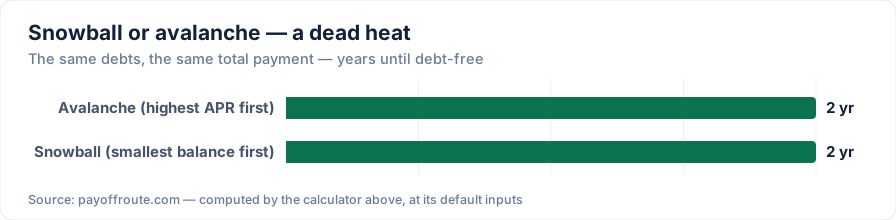
The first $200 of extra payment is worth $3,883 in avoided interest and cuts three years off the timeline. Note that every row above is identical under snowball and avalanche — with these two cards the smallest balance happens to also carry the highest APR, so both strategies attack the same card first and the two plans are the same plan. That is more common than people expect, and it is why running the numbers beats arguing about method.
The minimum payment trap
Card issuers typically set minimum payments at just 1–3% of your balance — barely above the interest that accrues each month. Pay only the minimum on a $6,000 balance at 24% APR and you’ll be paying for roughly two decades, handing the bank more in interest than you originally borrowed. Even a modest fixed extra payment breaks this cycle, because every extra dollar goes straight at the principal. Try changing the “extra payment” field above from $0 to $100 and watch what happens to your debt-free date.
Five ways to speed up your payoff
- Stop new charges on the cards you’re attacking. A payoff plan only converges if the balances stop growing. Switch day-to-day spending to debit while you work the plan.
- Ask for a rate reduction. A five-minute call to your issuer requesting a lower APR works more often than people think, especially with a good payment history.
- Consider a 0% balance-transfer card. Moving a high-APR balance to a 12–21 month 0% promotional card (typical fee: 3–5%) can redirect all of your payment to principal. It only helps if you can realistically clear the balance before the promo rate expires.
- Consolidate carefully. A fixed-rate personal loan or a home equity loan at a much lower rate can cut years off the payoff — but home-secured options put your house behind the debt, so treat them as a tool for disciplined borrowers, not a quick fix.
- Harvest one-time money. Tax refunds, bonuses, and sold clutter aimed at your target card create permanent interest savings — the earlier in the plan, the bigger the effect.
Snowball or avalanche — which pays off debt faster?
Avalanche is never slower and never more expensive — attacking the highest rate first is mathematically optimal, so it either ties the snowball or beats it. The honest question is by how much. When your APRs sit close together, or when your smallest balance is already your highest-rate card (as with the two seeded cards above, where both plans finish in 2 yr for $2,016), the gap is exactly zero and the debate is meaningless. When rates are spread wide, avalanche pulls ahead. Enter your own cards and read the gap before you pick a side.
| Factor | Snowball | Avalanche |
|---|---|---|
| Total interest paid | Higher (usually) | Lowest possible |
| Time to debt-free | Same or longer | Same or shorter |
| First win arrives | Fast — smallest card dies first | Can take a while if the highest-APR card is large |
| Best for | Motivation-driven payers, many small debts | Numbers-driven payers, widely varying APRs |
Research on debt repayment behavior has found that people who concentrate payments and see accounts close early are more likely to finish their plan — which is the strongest argument for snowball despite its higher cost on paper. The best plan is the one that survives contact with real life. Run both numbers above, look at the gap, and decide with open eyes.
Frequently Asked Questions
What is the difference between the snowball and avalanche methods?
Both methods pay the minimum on every card and send all extra money to one target card. The snowball method targets the smallest balance first for quick psychological wins. The avalanche method targets the highest APR first, which minimizes total interest paid. Avalanche is mathematically cheaper; snowball is easier to stick with for many people.
Which payoff method should I choose?
If the interest savings between the two methods is small (this calculator shows you the exact difference), choose whichever keeps you motivated. If the avalanche saves you hundreds or thousands of dollars — which happens when your card APRs vary widely — the math strongly favors avalanche.
Why does paying only the minimum take so long?
Minimum payments are typically set at 1–3% of your balance, barely above the monthly interest charge. Most of each payment goes to interest, so the principal shrinks extremely slowly. On a typical card, minimum-only payments can stretch a debt over 15–25 years and cost more in interest than the original balance.
Should I consolidate my credit cards instead?
Consolidation (a personal loan, balance-transfer card, or home equity loan) can cut your interest rate significantly, which shortens the payoff at the same monthly budget. It works only if you stop adding new charges to the cleared cards. Be especially careful using home equity: you would be converting unsecured debt into debt backed by your house.
Do extra payments hurt my credit score?
No — the opposite. Paying down balances lowers your credit utilization ratio, one of the largest factors in your score. Scores typically improve as balances fall, especially once utilization drops below 30% and then below 10%.
Is my data saved anywhere?
No. This calculator runs entirely in your browser. Balances and rates you enter are never stored or transmitted.
Read more on this
Minimum Payment Statistics: How Long Credit Card Debt Really Lasts
Original data: how many years minimum payments take at every common balance and APR, computed month by month — including the balances that never pay off at all.
Read →What an Extra $100 a Month Does to Your Debt: The Full Tables
Original data: how much time and interest an extra $100/month cuts from a mortgage, student loans, an auto loan, a personal loan, and a credit card — including the debts it outright rescues.
Read →How Is Your Credit Card Minimum Payment Calculated?
The two formulas US card issuers use to set your minimum payment, where your card's exact formula is written down, and why it matters at today's APRs.
Read →Related calculators
Balance Transfer
Is a 0% balance transfer worth the fee? Compare keeping your card vs transferring, month by month.
Open calculator →Loan vs Transfer
The two main escapes from card debt, compared honestly: fixed-rate loan vs 0% intro offer, fees included, same monthly budget.
Open calculator →Transfer Fee
What the 3–5% transfer fee costs in dollars, how many days of interest it buys back, and the exact balance where it stops being worth paying.
Open calculator →Disclaimer: This calculator is for educational purposes only and provides estimates based on the numbers you enter. It is not financial, legal, or tax advice. Actual loan terms, rates, and payments depend on your lender and personal circumstances. All calculations run in your browser — nothing you enter is stored or sent anywhere.